
Yonopress: What It Is, What You Can Find There, and How to Use It
If you came across the word Yonopress while searching Google, you may have wondered what it actually means. Is it a news website? A technology blog? An online magazine? Or something else?
The answer is a little more interesting than a single category.
Yonopress.com presents itself as a general online publication covering several areas, including technology, education, business, finance, health, travel, lifestyle, fashion, and other subjects. Instead of building the entire website around one narrow topic, it tries to give readers a collection of articles they can browse depending on what they need at the moment.
I took a closer look at the site because the name can be confusing, especially when similar Yonopress domains appear in search results. What stood out to me was the variety of subjects rather than one specific product or service.
That makes Yonopress potentially useful for casual research, but it also means readers should approach different categories differently. A travel article, for example, can be useful for getting ideas, while a health or finance article deserves more careful verification before you make an important personal decision.
What Is Yonopress?
Yonopress.com describes itself as an online publication created for people looking for useful information, practical ideas, and interesting stories.
The website is organized into multiple categories. Among the sections visible on the site are:
- Technology
- Education
- Business
- Finance
- Health
- Travel
- Lifestyle
- Fashion
- Literature
- SEO
- AI
- General-interest topics
This broad approach is similar to what you might find in a modern digital magazine rather than a specialist website.
For a reader, that has one obvious advantage: you don’t have to visit several different blogs just to explore unrelated subjects.
For example, someone might visit Yonopress to read about an AI-related topic and later browse a travel guide or educational article. The experience is more like browsing an online magazine than using a dedicated technical reference site.
Why Are People Searching for Yonopress?
Searches for a website name usually happen for a few simple reasons.
Someone may have seen a Yonopress article in Google Search. Another person may have received a link from social media. Others may be trying to determine whether the website is a news publication, blog, or online service.
There is also an important reason to be careful with the name.
Several websites using the Yonopress name or similar domains exist online. For example, Yonopress.com and Yonopress.io are not the same website. The .io version describes itself as a platform focused more specifically on SEO and AI tool reviews, guides, and digital marketing resources.
So if you are searching for Yonopress, check the domain before assuming that every page using the name belongs to the same organization.
That small step can prevent a lot of confusion.
What Can You Read on Yonopress?
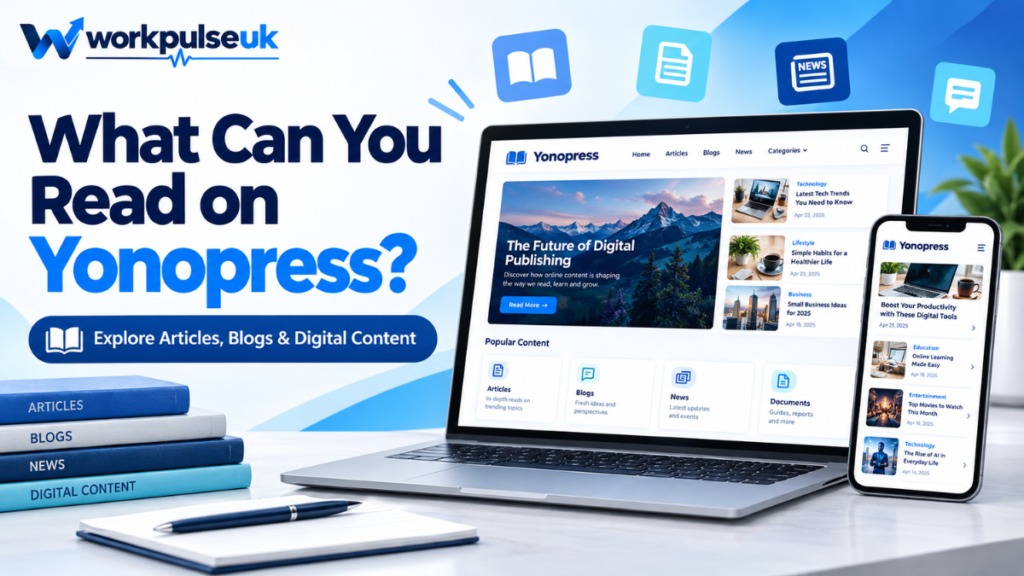
The easiest way to understand Yonopress is to look at the type of subjects it publishes.
Technology
Technology is one of the site’s broader areas.
Articles in this category can be useful when you’re trying to understand a technology trend without wanting to read highly technical documentation.
For example, a beginner researching AI tools may prefer a straightforward explanation of what a tool does before deciding whether to investigate it further.
The same applies to topics such as software, internet services, artificial intelligence, and digital trends.
My practical advice here is simple: use a general technology article as a starting point, not necessarily as the final technical authority. For software specifications, security information, pricing, or product changes, check the developer’s official website as well.
Education
The education section can be useful for students, parents, teachers, and general readers.
Educational content often works best when you use it to understand a subject first and then compare it with your textbook, school material, or other trusted educational sources.
For example, if you’re struggling to understand a concept before an exam, reading a simple explanation online can help you get unstuck. But I wouldn’t rely on one website alone for an important academic assignment.
A good habit is to compare definitions, dates, formulas, and quotations with your school’s recommended material.
Business and Finance
Yonopress also publishes business and finance-related material.
This can be useful for learning basic concepts such as business ideas, money management, insurance, entrepreneurship, or changes in the wider financial environment.
However, finance is one area where readers should slow down.
An article can explain a financial concept without being personalized financial advice. Your income, country, taxes, debt, investments, and personal circumstances can completely change what makes sense for you.
So if an article discusses investing, loans, insurance, taxes, or another major financial decision, treat it as general information and verify important details with an appropriate professional or primary source.
Health
Health articles can be interesting because readers often search the internet when they have a question they want answered quickly.
But this is another category where common sense matters.
A general article about nutrition, sleep, exercise, or wellness may provide useful background information. It should not replace a doctor’s diagnosis or treatment plan.
One mistake I frequently see people make with health content is treating a search result as if it were a medical consultation.
Don’t do that.
If symptoms are serious, persistent, unusual, or worrying, speak with a qualified healthcare professional instead of trying to diagnose yourself from several websites.
Travel and Lifestyle
Travel and lifestyle content is generally easier to use as inspiration.
You might discover an unfamiliar destination, learn about an activity, or get ideas for planning a trip.
For actual travel planning, however, always verify current information before leaving home. Hotel policies, ticket prices, opening hours, visa requirements, transport schedules, and entry rules can change.
A good workflow is:
- Read an article to discover the idea.
- Identify the places or services mentioned.
- Visit the official website of the relevant airline, hotel, attraction, government department, or transport provider.
- Check current prices and rules.
- Make your final decision using the latest information.
That approach saves you from turning an old blog post into an expensive mistake.
How I Would Use Yonopress for Research
If I were researching a topic through a general publication like Yonopress, I would not simply read one article and stop.
Instead, I’d use a three-step process.
Step 1: Start with the article
First, read the article to understand the basic subject.
Pay attention to terminology you don’t understand. If the article mentions a company, application, law, product, or organization, write down its exact name.
Step 2: Verify important details
Next, check important claims against a primary source.
For software, look at the developer’s website.
For government rules, check the relevant government department.
For health information, check reputable medical sources.
For financial products, check the provider’s current documentation and applicable regulations.
This is especially important when the article contains prices, dates, eligibility requirements, statistics, or instructions.
Step 3: Apply the information to your situation
Finally, ask whether the information actually applies to you.
This step is often skipped.
Suppose you read an article about a productivity application and decide to try it. Your phone might be an older Android model while the instructions were written using an iPhone. The buttons and menus may be completely different.
The information may still be correct, but your situation is different.
That’s why practical verification matters.
A Realistic Example: Using Yonopress for a Technology Question
Imagine you’re interested in artificial intelligence but don’t know much about it.
You find a Yonopress article discussing an AI tool.
Rather than immediately signing up, you could:
- Read the article to understand the basic idea.
- Open the tool’s official website.
- Check whether the service has a free plan.
- Look at supported devices and browsers.
- Read the privacy policy before uploading private information.
- Test it with a harmless sample task.
- Compare its result with another tool.
- Decide whether it actually solves your problem.
For example, if you’re using a Windows 11 laptop with Chrome, test the service there first. If you normally work from an Android phone, also check how the mobile experience behaves.
This takes a few extra minutes, but it gives you a much better idea of whether the tool fits your workflow.
Common Mistakes Readers Should Avoid
Mistake 1: Assuming every Yonopress website is the same
This is probably the easiest mistake to make.
Always look at the domain name.
A .com website and a .io website can represent completely different organizations, even when the branding looks similar.
Mistake 2: Treating every article as current
Online content can remain accessible long after circumstances change.
This matters particularly for:
- Software pricing
- AI tools
- Travel requirements
- Financial information
- Government rules
- Product specifications
Check the publication or update date whenever possible.
Mistake 3: Following instructions without checking your device
Technology guides often show screenshots from one browser, operating system, or phone.
A Windows user may see something different from a Mac user. Android menus can differ from iPhone menus. Chrome can behave differently from Safari or Firefox.
If something doesn’t match the instructions, don’t immediately assume you’ve done something wrong.
Check whether the guide was written for your platform.
Mistake 4: Confusing information with professional advice
This is particularly important for health, finance, taxes, and legal subjects.
A useful article can help you understand a question. It doesn’t automatically know your personal circumstances.
Is Yonopress Useful for Beginners?
It can be, particularly if you like reading about different subjects without jumping between highly specialized websites.
The broad category structure makes it possible to move from one topic to another fairly easily.
For beginners, the biggest benefit is readability. A general article can sometimes explain an unfamiliar concept in simpler language than technical documentation.
But there’s a trade-off.
A broad publication isn’t necessarily the best source for every specialized question. If you’re trying to solve a complicated programming problem, official developer documentation may be more useful. If you’re researching a medical condition, professional medical resources should take priority. If you’re checking a government rule, go directly to the government source.
Think of Yonopress as one part of your research process rather than the only source you need.
What About Yonopress.io?
This is worth mentioning because it can cause confusion in search results.
Yonopress.io presents itself differently from Yonopress.com. Its stated focus is SEO and AI tools, including reviews, comparisons, guides, and digital marketing resources.
That means someone searching for “Yonopress” could potentially land on either domain and assume they are looking at the same platform.
They’re worth treating as separate websites unless the sites themselves clearly establish a connection.
Before entering an email address, creating an account, downloading something, or paying for a service, check the domain carefully.
A Simple Way to Decide Whether an Article Is Worth Trusting
You don’t need to be an expert fact-checker.
Before relying heavily on an online article, ask five questions:
Who published it?
Look for an identifiable publication, author, or editorial information.
When was it published or updated?
A technically correct article from several years ago may no longer describe current software or rules.
What evidence is provided?
Important claims should ideally point toward reliable sources or documentation.
Is the subject high-risk?
Health, finance, legal matters, cybersecurity, and safety deserve more verification.
Can I confirm the important part elsewhere?
If the answer is yes, take a few minutes to verify it.
This habit is useful regardless of whether you’re reading Yonopress, another blog, a social media post, or a search result.
My Take on Using Yonopress
After looking through Yonopress.com, I would describe it primarily as a general-interest digital publication, rather than a single-purpose application or specialized service.
Its strength is the range of topics. You can find technology, education, business, lifestyle, travel, and other subjects under one site.
The main thing I’d keep in mind is that different subjects require different levels of verification.
If I’m looking for a quick explanation of a technology concept or an idea for something to explore, a general-interest article can be a convenient starting point.
If I’m making a medical, financial, legal, travel, or purchasing decision, I’d go one step further and verify the important details using primary or professional sources.
That’s a useful rule for almost any website: read broadly, but verify carefully when the decision matters.
And if you searched for “Yonopress” because you saw a particular article or domain and weren’t sure what you were looking at, checking the exact web address is the best place to start. The name is used by more than one online property, so the domain can tell you a lot before you even read the first paragraph.